World Hand Hygiene Day, observed every May 5, is the World Health Organization’s annual call to action on one of the most cost-effective public health interventions available. The 2026 theme, “Action Saves Lives,” challenges organizations to turn handwashing awareness into consistent practice.
But for millions of commercial spaces, venues, businesses, schools, and healthcare facilities, that action starts with access. If people can’t reach a sink, they won’t wash their hands. For spaces without permanent plumbing, portable handwashing stations are a way to turn that call to action into compliant, accessible hand hygiene. They deliver fully functional, code-compliant handwashing with no plumbing required, making proper hand hygiene possible in a variety of spaces.

Why Hand Hygiene Matters Beyond Healthcare
World Hand Hygiene Day is a global campaign led by the World Health Organization (WHO). The campaign began in 2009 inside hospitals, but the science and message behind it applies everywhere people work, eat, learn, and gather. Food service, schools, childcare, construction, and event venues all share the same fundamental challenge: making handwashing easy enough that people actually do it. The 2026 campaign marks 18 years of the SAVE LIVES: Clean Your Hands initiative, with WHO emphasizing that consistent hand hygiene at the right moments delivers measurable returns in both health outcomes and cost savings.
Beyond the public health benefits, accessible handwashing affects measurable business outcomes. The WHO reports that improving hand hygiene delivers approximately $16.50 in healthcare savings for every $1 invested, and broader infection prevention programs return 7 to 16 times their investment. For commercial operators and any organization with employees, customers, students, or patients on site, the data translate directly to the bottom line.
Hand Hygiene Cuts Absenteeism and Healthcare Costs
According to the CDC foundation, in the U.S., absenteeism costs employers an estimated $225.8 billion per year, or $1,685 per employee. A peer-reviewed workplace study published in the Journal of Occupational and Environmental Medicine found that comprehensive hand hygiene programs reduced hygiene-preventable healthcare claims by over 20% (Arbogast et al., 2016).
Handwashing Compliance and Health Inspection Outcomes
Failed health inspections can mean closure, fines, and reputational damage. Failed OSHA inspections at job sites can carry similar consequences. Putting a compliant handwashing station where it’s needed eliminates one of the most common citations.
Visible Hygiene Builds Customer and Employee Trust
Visible, accessible hand hygiene infrastructure signals that an organization takes safety seriously. In hospitality, foodservice, healthcare, childcare, or senior living, that signal matters to the people who choose where to spend their money or send their families.
Why Sink Accessibility Is the Missing Piece in Hand Hygiene
Knowing that handwashing matters is not enough. People wash their hands when a suitable sink is nearby and convenient, and they skip it when it isn’t. Accessibility and ease of use are what truly drive habit forming actions in busy environments.
This is the gap that posters and training campaigns alone cannot close. When the nearest sink is across the building, behind a locked door, or doesn’t exist at all, behavior change stalls regardless of how strong the messaging is. This is the gap portable sinks were built to fill. They make handwashing accessible exactly where it needs to happen.
In many commercial environments, installing conventional plumbing isn’t possible, either because the space won’t allow it or because it’s too costly and disruptive to daily operations. These are the environments where compliant handwashing access most often breaks down.
The ROI of Portable Handwashing Sinks vs. Permanent Plumbing
If your facility lacks handwashing access in a specific area, the default assumption is to hire a contractor and run new lines. Before you do, look at the numbers.
Installing New Plumbing Lines Is Expensive and Disruptive
Rough-in costs for commercial plumbing in new construction run $4 to $6 per square foot, and fixture costs are considerably higher because of the heavy-duty nature of commercial fixtures designed for public use. Then there’s the added cost of permits, general contractor overhead, and labor. The sticker price tells only part of the story. New plumbing also brings:
- Downtime. Construction in active commercial spaces means closed sections, lost revenue, and disrupted operations.
- Structural modifications. Running pipes through existing walls, slabs, or finished ceilings often means demolition and restoration work that compounds quickly.
- Permanent commitment. Once installed, a hard-plumbed sink stays where it was installed, even if your floor plan, lease, or operations change.
For evolving operations, portable sinks change the math entirely. They deliver compliant handwashing access without permanent infrastructure, permits, or contractors.
Portable Sinks: Lower Upfront Cost, No Plumbing Required
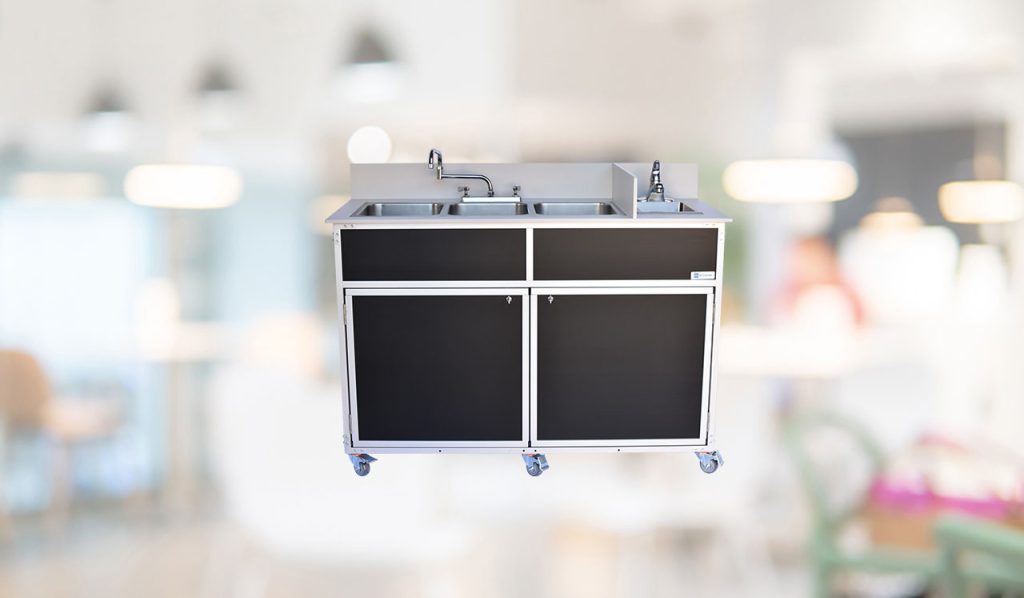
Portable sinks are self-contained, offering operational flexibility that permanent infrastructure does not. They have an integrated plumbing system that includes a freshwater tank, a wastewater tank, water pump, and—for most models—an adjustable water heater, all powered by a standard electrical outlet. Monsam portable sinks are mobile and arrive ready-to-use, so they can support the dynamics of your operation upon delivery. No permit complications, no landlord approvals, and no abandoned fixtures when you reconfigure your space. Units can serve multiple locations or events throughout the year, support seasonal expansions, or relocate when a lease ends. For businesses that are expanding operations, or any organization that occupies leased space, that flexibility has real dollar value.Browse the full Monsam portable sink lineup to see options for every environment.

The Solution When Permanent Plumbing Isn’t an Option
Event Venues, Festivals, and Public Gatherings
Sporting events, outdoor fairs, and community gatherings draw crowds to spaces where fixed handwashing infrastructure is often limited. A handful of portable sinks turn any venue into one with proper hygiene access for both staff and attendees.
Mobile and Outdoor Food Service
Concession stands, food halls, catering operations, and pop-up vendors are required to provide handwashing facilities under FDA Food Code guidelines and most state and local health regulations. Running plumbing to a temporary location can often be challenging or impossible. NSF-certified portable sinks meet code requirements while evolving with the operation.
Healthcare Facilities
Healthcare facilities, especially those in non-traditional settings, such as mobile clinics, vaccination sites, community health facilities, dialysis centers, and field hospitals all need to support the WHO’s “5 Moments for Hand Hygiene” at the point of care. Many of these settings operate in spaces never designed for clinical use. Portable sinks bring infection control directly to the patient without renovation.
Schools, Childcare, and Outdoor Learning
Classrooms, art rooms, science labs, lunchrooms, and outdoor learning spaces often have no nearby sink. The CDC identifies hand hygiene as one of the most effective measures for reducing illness transmission in schools, yet many of the highest-traffic areas lack access. A portable unit puts handwashing where students actually need it.
Disaster Response and Emergency Operations
In the wake of natural disasters, displacement events, or public health emergencies, normal infrastructure is often unavailable. Portable handwashing stations are deployable immediately and operate without utility connections, making them essential to first response and shelter operations.
What to Look for When Choosing a Portable Sink
Not every portable sink is built for every environment. Before purchasing, evaluate:
- Tank capacity. Match fresh and wastewater tank sizes to your expected daily handwashing volume. Higher-traffic settings need larger tanks to avoid frequent refills.
- Hot water capability. Required in most food service codes and standard practice in healthcare. Confirm the unit produces hot water, not just temperature-mixed water.
- NSF certification. The clearest signal that a unit meets recognized public health standards.
- ADA compliance. Required in many public-facing environments. ADA-compliant models are designed for wheelchair access and proper reach ranges.
- Power source. Standard electrical outlet, manual foot pump, or battery-powered for off-grid operation.
- Mobility. Casters, weight, and footprint determine how easily the unit can be repositioned.
- Built-in dispensers. Having the option to add soap and towel dispensers improve hygiene compliance and simplify maintenance.
- Materials and construction. Stainless steel basin, antimicrobial surfaces, durable-lightweight materials, and commercial-grade build matter for longevity in demanding environments.
A Monsam specialist can match the right model to your application or work with you to design a unit that meets your needs. Talk to a specialist for recommendations based on your facility, traffic volume, and code requirements.
Your Action Plan for World Hand Hygiene Day 2026
May 5 is a useful deadline for converting intention into action. Make the day matter by using this practical checklist:
- Tour your facility. Note every location where the nearest handwashing sink is not within the reach of where staff or visitors actually need it.
- Identify your highest-impact gaps. Prioritize areas where compliance, customer experience, or inspection risk is most affected.
- Compare costs. Get a quote for adding plumbing in one of those locations, then compare it to a portable sink. The numbers usually favor portable by a wide margin.
- Speak with your local health department. Before deciding on a solution, understand the codes and hygiene requirements you need to meet to pass your health inspection.
- Share resources with your team. The WHO maintains a free campaign toolkit with posters, social assets, and training materials.
Ready to Improve Handwashing Access in Your Facility?
World Hand Hygiene Day is the right moment to close the gap between intention and action. Meeting hand hygiene requirements does not have to involve costly construction or operational disruption. If your facility has areas where people can’t easily wash their hands, a Monsam portable sink gives you a faster, accessible, and more flexible way to stay compliant while protecting revenue.
Frequent Asked Questions
Can portable sinks be used in stadiums and large venues?
Yes. They are widely used for concessions, stadiums, arenas, modular or temporary space, pop-up experiences, and outdoor events where plumbing access is limited.
Do portable sinks provide hot water?
Most Monsam portable models include a built-in water heater to meet compliance standards. Monsam hot water portable sinks can be set from 95 to 140 degrees F.
How quickly can portable sinks be deployed?
Monsam units arrive ready to use. They can be set up and operational within minutes, making them ideal for urgent compliance needs.
Do portable sinks meet health department requirements?
Requirements vary by jurisdiction, so we strongly recommend confirming with your local health authority before purchasing. Many jurisdictions accept portable sinks as long as they provide hot running water, and proper wastewater containment.
How often does a portable sink need to be refilled?
That depends on the tank size and usage volume. Monsam offers models with tank capacities suited to everything from low-traffic classrooms to high-volume event environments. A Monsam specialist can recommend the right unit based on your use case and expected daily usage.
Can a portable sink be used outdoors?
Yes. Monsam offers models built for outdoor use at events, construction sites, and mobile food operations.
Are portable handwashing sinks NSF certified?
Monsam offers portable sinks and concession carts that are NSF certified. These units meet stringent food safety and sanitation standards established by the National Sanitation Foundation (NSF) – an esteemed, independent public health certification organization.
Are portable sinks ADA compliant?
Monsam manufactures ADA-compliant portable sink models designed to meet accessibility standards for living spaces, healthcare environments, and workplaces.
Can portable sinks be used in stadiums and large venues?
Yes. They are widely used for concessions, stadiums, arenas, modular or temporary space, pop-up experiences, and outdoor events where plumbing access is limited.